


The countries most likely to blow up this time around are the so called "PIIGS": Portugal, Ireland, Italy, Greece, and Spain. One ore more of them, Faber says, will likely default in the next couple of years.
And, that could prove disastrous for the Euro currency.
Saturday, January 16, 2010


2010: The Best of Times or the Worst?
“It was the best of times. It was the worst of times.”
– Charles Dickens
By Robert Kiyosaki
Is the recession over? Are happy days really here again? Paraphrasing Dickens, my answer is, “For people who are prepared, 2010 will be the best of times. For many, 2010 will be the worst of times.”
The following are a few of my predictions and reasons behind them…
Prediction #1: The real estate market will crash again.
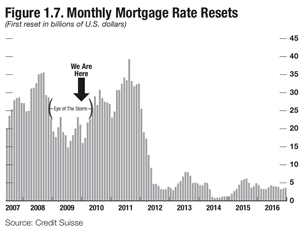
Pictured above is a graph of mortgage resets. In simple terms, a mortgage reset is when a mortgage comes due. In normal times, refinancing was a simple process…but these are not normal times. Some points of interest:
1. In September 2008, the mortgage resets hit $35 billion that month. That was the exact time the financial crisis hit. When people could not afford to refinance and began to default, the stock market and banking industry crashed.
2. The eye of the storm: In the summer of 2009 mortgage resets were low -- around $15 billion a month. This is when optimists began to see “green shoots” in the economy. The green shoots were the eye of the storm. In 2010, as I see it, the second half of the financial hurricane hits. By late 2011, the resets climb to nearly $40 billion a month. The storm will not end until 2012.
3. The first half of the storm was primarily due to subprime defaults. The second half of the storm will hit more solid homeowners. The question is, can they weather the storm? Will Mac Mansion foreclosures be next?
4. In America, there are over 40 million people who own more than two homes. Can they afford to carry and refinance two or more mortgages?
5. Since home values have gone down, many homeowners will find they owe more than their home(s) are worth. Will the bank be kind to them?
6. The time for using your home as an ATM is over. This is crushing retailers and retail real estate. Shopping centers are in trouble. Strip malls are empyting as shopkeepers close -- permanently. This will lead to the crash of the office, warehouse, and other commercial properties.
My prediction: Obviously these are the best of times if you are a buyer of distressed properties and the worst of times if you are a seller.
Other things I am watching for in 2010:
1. Will China crash? America’s crash has hit China in the gut. The Chinese are laying off millions of workers. Only massive government bailout is keeping the economy afloat. The Chinese boom will eventually go bust…but will it bust in 2010? Only time will tell.
2. When America stopped importing from China, China stopped importing from the rest of the world. This affects Asian countries as well as Australia, Brazil, and other suppliers of raw materials.
3. Fed Chairman Ben Bernanke is replacing toxic debt with new debt. By protecting his friends in the mega-banks, he is turning the U.S. into a zombie nation. The recession is over, but America is entering an era we will be calling The New Depression, a period when the rich become extremely rich but everyone else becomes poorer. Taxes will kill anyone working for a paycheck.
4. The U.S. dollar will grow weaker. If the dollar strengthens, we will have more unemployment because our goods become too expensive and we will export less.
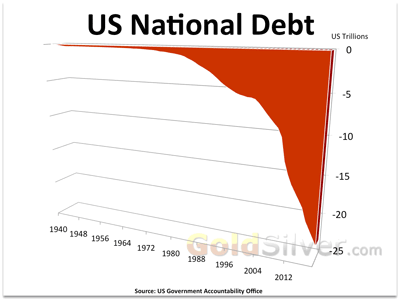
5. The deficit will increase. The bailouts for the rich are killing the economy.
6. Israel may attack Iran. Israel will not tolerate Iran developing nuclear power, even if Iran claims it is for peaceful purposes. If there is an attack, oil prices will go through the roof.
7. Dead cat bounce. The current stock market rally will probably turn into a dead cat bounce. If the Dow drops below 6500, 5,000 may be the next stop.
The Best of Times
I know I sound painfully pessimistic. I know my predictions are bad news for most people. Yet, for others, bad news is good news.
The following are the bright spots for people who are prepared.
Prediction #2: Gold, silver, and oil will continue to be safe investments in 2010.
The following recaps the year-end prices of gold and silver:
YEAR GOLD SILVER
2000 $ 273 $ 4.57
2001 $ 279 $ 4.57
2002 $ 348 $ 4.78
2003 $ 416 $ 5.92
2004 $ 438 $ 6.79
2005 $ 518 $ 8.80
2006 $ 638 $12.78
2007 $ 838 $14.77
2008 $ 882 $11.33
2009 $1100 (approx) $17.50 (approx)
In 2009, the Dow rose approximately 18%. Gold rose approximately 25%. Silver rose approximately 50%.
By the end of 2010, I predict gold will be at $1,775 an ounce, silver at $24 an ounce, and oil at $85 a barrel. If Israel attacks Iran, these predictions will be blown away.
Prediction #3: The next market to crash will be commercial real estate.
Cash flow positive real estate will be even more affordable. 2010 through 2012 will be a real estate buffet for those with cash and access to credit.
My Personal Investments
As I stated in 2002, “You have up to the year 2010 to become prepared.”
The following are things I have done to prepare myself:
1. I started The Rich Dad Company in 1997 because I saw this crisis coming. For the past three years, I have tightened internal controls and prepared for global expansion via a franchise distribution system. The company is debt free with strong income.
2. 2009 was my best real estate year to date. With the Fed handing out large sums of money and pension funds looking for projects to invest in, my real estate holding company has acquired tens of millions of dollars for acquisition of bankrupt properties and development projects. Development projects are affordable again, as labor, material, and land costs are low and the government is generous with 40-year, low interest, non-recourse loans. People still need a roof over their heads.
3. My oil development projects have done well. We drilled three wells and hit oil on two of them. Government tax breaks for oil exploration remain generous, even for dry holes. Even if the economy crashes, we will still burn oil.
4. I took 90% of my money out of the stock market in 2007. If the Fed raises interest rates, the stock market and real estate market will collapse.
5. I loaded up on gold and silver between 1996 and 2004.
6. With the Fed printing trillions of dollars, cash is trash and savers are losers. As soon as I have excess cash I invest in oil, real estate, gold, and silver.
7. In a zero-interest-rate environment, debtors are winners…but only if you have good debt…debt that’s paid by tenants.
In Conclusion
A few years ago, Japan was ‘King of the Financial World.’ Japan’s economy was the world’s second largest economy -- till the bubble burst in 1990. Japan’s budget went into deficit in 1993. Since then, the deficit has averaged 5.4 percent of GDP per year. As a result, Japanese government debt is now 200 percentof GDP today. The U.S. is following Japan, and China will follow the U.S.
We will not see much inflation because the Fed is not able to print enough money to replace the losses from the burst of the credit bubble. Also, factories have too much excess capacity due to lack of demand, which means prices for consumer goods will remain low and unemployment will remain high. Instead, we will see inflation in gold, silver, oil, some stocks, some real estate sectors, and food -- not because values are going up but because the dollar is going down.
Welcome to The New Depression. And may these times be the best of times for you.
– Charles Dickens
By Robert Kiyosaki
Is the recession over? Are happy days really here again? Paraphrasing Dickens, my answer is, “For people who are prepared, 2010 will be the best of times. For many, 2010 will be the worst of times.”
The following are a few of my predictions and reasons behind them…
Prediction #1: The real estate market will crash again.
Pictured above is a graph of mortgage resets. In simple terms, a mortgage reset is when a mortgage comes due. In normal times, refinancing was a simple process…but these are not normal times. Some points of interest:
1. In September 2008, the mortgage resets hit $35 billion that month. That was the exact time the financial crisis hit. When people could not afford to refinance and began to default, the stock market and banking industry crashed.
2. The eye of the storm: In the summer of 2009 mortgage resets were low -- around $15 billion a month. This is when optimists began to see “green shoots” in the economy. The green shoots were the eye of the storm. In 2010, as I see it, the second half of the financial hurricane hits. By late 2011, the resets climb to nearly $40 billion a month. The storm will not end until 2012.
3. The first half of the storm was primarily due to subprime defaults. The second half of the storm will hit more solid homeowners. The question is, can they weather the storm? Will Mac Mansion foreclosures be next?
4. In America, there are over 40 million people who own more than two homes. Can they afford to carry and refinance two or more mortgages?
5. Since home values have gone down, many homeowners will find they owe more than their home(s) are worth. Will the bank be kind to them?
6. The time for using your home as an ATM is over. This is crushing retailers and retail real estate. Shopping centers are in trouble. Strip malls are empyting as shopkeepers close -- permanently. This will lead to the crash of the office, warehouse, and other commercial properties.
My prediction: Obviously these are the best of times if you are a buyer of distressed properties and the worst of times if you are a seller.
Other things I am watching for in 2010:
1. Will China crash? America’s crash has hit China in the gut. The Chinese are laying off millions of workers. Only massive government bailout is keeping the economy afloat. The Chinese boom will eventually go bust…but will it bust in 2010? Only time will tell.
2. When America stopped importing from China, China stopped importing from the rest of the world. This affects Asian countries as well as Australia, Brazil, and other suppliers of raw materials.
3. Fed Chairman Ben Bernanke is replacing toxic debt with new debt. By protecting his friends in the mega-banks, he is turning the U.S. into a zombie nation. The recession is over, but America is entering an era we will be calling The New Depression, a period when the rich become extremely rich but everyone else becomes poorer. Taxes will kill anyone working for a paycheck.
4. The U.S. dollar will grow weaker. If the dollar strengthens, we will have more unemployment because our goods become too expensive and we will export less.
5. The deficit will increase. The bailouts for the rich are killing the economy.
6. Israel may attack Iran. Israel will not tolerate Iran developing nuclear power, even if Iran claims it is for peaceful purposes. If there is an attack, oil prices will go through the roof.
7. Dead cat bounce. The current stock market rally will probably turn into a dead cat bounce. If the Dow drops below 6500, 5,000 may be the next stop.
The Best of Times
I know I sound painfully pessimistic. I know my predictions are bad news for most people. Yet, for others, bad news is good news.
The following are the bright spots for people who are prepared.
Prediction #2: Gold, silver, and oil will continue to be safe investments in 2010.
The following recaps the year-end prices of gold and silver:
YEAR GOLD SILVER
2000 $ 273 $ 4.57
2001 $ 279 $ 4.57
2002 $ 348 $ 4.78
2003 $ 416 $ 5.92
2004 $ 438 $ 6.79
2005 $ 518 $ 8.80
2006 $ 638 $12.78
2007 $ 838 $14.77
2008 $ 882 $11.33
2009 $1100 (approx) $17.50 (approx)
In 2009, the Dow rose approximately 18%. Gold rose approximately 25%. Silver rose approximately 50%.
By the end of 2010, I predict gold will be at $1,775 an ounce, silver at $24 an ounce, and oil at $85 a barrel. If Israel attacks Iran, these predictions will be blown away.
Prediction #3: The next market to crash will be commercial real estate.
Cash flow positive real estate will be even more affordable. 2010 through 2012 will be a real estate buffet for those with cash and access to credit.
My Personal Investments
As I stated in 2002, “You have up to the year 2010 to become prepared.”
The following are things I have done to prepare myself:
1. I started The Rich Dad Company in 1997 because I saw this crisis coming. For the past three years, I have tightened internal controls and prepared for global expansion via a franchise distribution system. The company is debt free with strong income.
2. 2009 was my best real estate year to date. With the Fed handing out large sums of money and pension funds looking for projects to invest in, my real estate holding company has acquired tens of millions of dollars for acquisition of bankrupt properties and development projects. Development projects are affordable again, as labor, material, and land costs are low and the government is generous with 40-year, low interest, non-recourse loans. People still need a roof over their heads.
3. My oil development projects have done well. We drilled three wells and hit oil on two of them. Government tax breaks for oil exploration remain generous, even for dry holes. Even if the economy crashes, we will still burn oil.
4. I took 90% of my money out of the stock market in 2007. If the Fed raises interest rates, the stock market and real estate market will collapse.
5. I loaded up on gold and silver between 1996 and 2004.
6. With the Fed printing trillions of dollars, cash is trash and savers are losers. As soon as I have excess cash I invest in oil, real estate, gold, and silver.
7. In a zero-interest-rate environment, debtors are winners…but only if you have good debt…debt that’s paid by tenants.
In Conclusion
A few years ago, Japan was ‘King of the Financial World.’ Japan’s economy was the world’s second largest economy -- till the bubble burst in 1990. Japan’s budget went into deficit in 1993. Since then, the deficit has averaged 5.4 percent of GDP per year. As a result, Japanese government debt is now 200 percentof GDP today. The U.S. is following Japan, and China will follow the U.S.
We will not see much inflation because the Fed is not able to print enough money to replace the losses from the burst of the credit bubble. Also, factories have too much excess capacity due to lack of demand, which means prices for consumer goods will remain low and unemployment will remain high. Instead, we will see inflation in gold, silver, oil, some stocks, some real estate sectors, and food -- not because values are going up but because the dollar is going down.
Welcome to The New Depression. And may these times be the best of times for you.
Marc Faber: "We Are Doomed"
The U.S. is headed for a major debt crisis, Marc Faber says.
It won't hit us this year or next year. But within 5-10 years, the United States will be forced to quietly default on its debt, most likely by printing money and destroying the value of the currency.
The main problem comes down to two things: 1) ballooning debts and 2) future interest costs.
In the past decade, the U.S. government's total debt and liabilities have gone through the roof, especially when Fannie, Freddie, Medicare, and Social Security are taken into account. This trend is unsustainable, and it will correct itself only through a rapid acceleration of economic growth and tax revenues, a new-found financial discipline, or a crisis--or a combination of all three.
The second problem is interest costs. Right now, the government's debt and deficits aren't creating an undue burden because the government can borrow so cheaply. Eventually, however, as the country's financial situation gets weaker, interest rates will likely rise, and our interest costs will go through the roof.
According to Faber, our annual interest costs currently amount to 12% of the government's tax revenue. Within five years, Faber estimates, these costs will soar to 35% of tax revenue. This will force the government to cut spending (unlikely) and/or frantically print money.
It won't hit us this year or next year. But within 5-10 years, the United States will be forced to quietly default on its debt, most likely by printing money and destroying the value of the currency.
The main problem comes down to two things: 1) ballooning debts and 2) future interest costs.
In the past decade, the U.S. government's total debt and liabilities have gone through the roof, especially when Fannie, Freddie, Medicare, and Social Security are taken into account. This trend is unsustainable, and it will correct itself only through a rapid acceleration of economic growth and tax revenues, a new-found financial discipline, or a crisis--or a combination of all three.
The second problem is interest costs. Right now, the government's debt and deficits aren't creating an undue burden because the government can borrow so cheaply. Eventually, however, as the country's financial situation gets weaker, interest rates will likely rise, and our interest costs will go through the roof.
According to Faber, our annual interest costs currently amount to 12% of the government's tax revenue. Within five years, Faber estimates, these costs will soar to 35% of tax revenue. This will force the government to cut spending (unlikely) and/or frantically print money.
China eager to buy IMF gold for $1,000 per ounce
By David Lew
BEIJING: Two months after India’s Reserve Bank made big global news with the purchase of 200 tonnes of gold from the International Monetary Fund (IMF), bullion traders are now waiting for the ‘golden’ news of 2010. The news in question: Will China buy the remaining 203 tonnes of gold from IMF soon?
You Can Buy Gold Here
Bullion trader and gold investors in China want the dragon country to take the plunge and buy the rest of the IMF gold, following India’s footsteps. India bought 200 tonnes of IMF gold for $1,045 an ounce. Soon after the India purchase, gold price zoomed to touch a high of $1,227 per ounce in November last year. Since then, the yellow metal price has come down. Gold is these days hovering around the $1,100-1,150 price range.
Last year, IMF approved the long-talked-about sale of 1/8th of its holdings, in "a volume strictly limited to 403.3 metric tons, with these sales to be conducted under modalities that safeguard against disruption of the gold market." The main IMF parameter to sell its gold reserve was that the sale has to be done at current market prices. So, now, the moot question is whether China will take the next step and buy 203 tonnes of gold from IMF at the current market price--$1,100-1,150 range?
Buying gold at the current market price would mean that China will be paying almost the same money per ounce of gold that India paid to IMF. Bullion experts recommend that China should go in for the IMF gold buy in this new year, as otherwise its ambitious task to mop up 10,000 tonnes of gold reserves in the next 10 years may be difficult to achieve.
The Chinese Central Bank—the People’s Bank of China—now holds record amounts of US dollars. But the gold holding of the Chinese central bank is at a paltry 1.8%. “China has set a big plan to mop up its gold reserves to beat the United States in the next 10 years. Currently, the gold reserves with the People’s Bank of China are the lowest for any central bank holdings, taking into account the booming Chinese economy,” says Jong-Yoon Chai, a bullion analyst based in Beijing.
According to him, even if China decides to buy 200 tonnes of gold from IMF, it will barely add up to 2% of the foreign exchange reserves of the Chinese central bank. “This is insignificant considering the big gold reserves target that China has set. So, it will be prudent if China buys IMF gold as early as possible before some other countries, may be India again, jumps into the fray to grab more gold from the IMF,” Jong-Yoon Chai told Commodity Online.
Jong-Yoon Chai says China is worried about the high price of gold when it comes to buying the IMF gold. “In fact, much before India decided to buy the IMF gold, the Chinese central bank had discussed and finalized plans to purchase the yellow metal from the global organization. One Chinese central bank official had even pronounced last year that China would buy IMF gold over a telephone call,” he says.
“But what prevented China from buying the IMF gold as per its wish was the zooming price of the precious metal last year. China thought gold prices would cool down to $800 per ounce and that would be the right opportunity. But gold at $800 per ounce was a price phenomenon of 2009 January. Now it will be impossible that gold price will dip to that level. So the best course of action for China now is to jump blindly at the IMF gold and grab it," Jong-Yoon Chai added.
Soon after India bought the IMF gold, Wei Benhua, former deputy head of the Chinese state administration of foreign exchange (SAFE), in an interview by the Chinese business magazine Caijing: “At present we should not buy. Instead we should wait for the IMF to sell gold next time, when the price of gold drops to a relatively low level, say, about $800 per ounce.”
Several central banks from China, Russia, Brazil, and even a small country like Sri Lanka are said to be in the fray to buy the rest of the IMF gold reserves. It cannot also be ruled that India will be buying out the complete stock of IMF gold reserves.
Dubai-based bullion analyst Mark Robison feels that China is waiting for gold price to dip further to buy the IMF gold. "My reading is that China is eager to buy gold for a price around $1,000 per ounce. The Chinese central bank is waiting for the right opportunity in bullion prices to jump into the IMF gold reserves," Robinson said.
China is the world’s biggest gold producer. In April, China increased reserves of gold by 76 percent to 1,054 tons since 2003. GFMS recently predicted that China will overtake India as the largest consumer of gold in the world.
China is willing to buy IMF gold, but not at the high price that India paid. Gold price may be zooming to records; but China wants to wait and watch so that price of the yellow metal crashes to realistic levels. Now, the question is will China be able to buy IMF gold at $1,000 per ounce in 2010.
BEIJING: Two months after India’s Reserve Bank made big global news with the purchase of 200 tonnes of gold from the International Monetary Fund (IMF), bullion traders are now waiting for the ‘golden’ news of 2010. The news in question: Will China buy the remaining 203 tonnes of gold from IMF soon?
You Can Buy Gold Here
Bullion trader and gold investors in China want the dragon country to take the plunge and buy the rest of the IMF gold, following India’s footsteps. India bought 200 tonnes of IMF gold for $1,045 an ounce. Soon after the India purchase, gold price zoomed to touch a high of $1,227 per ounce in November last year. Since then, the yellow metal price has come down. Gold is these days hovering around the $1,100-1,150 price range.
Last year, IMF approved the long-talked-about sale of 1/8th of its holdings, in "a volume strictly limited to 403.3 metric tons, with these sales to be conducted under modalities that safeguard against disruption of the gold market." The main IMF parameter to sell its gold reserve was that the sale has to be done at current market prices. So, now, the moot question is whether China will take the next step and buy 203 tonnes of gold from IMF at the current market price--$1,100-1,150 range?
Buying gold at the current market price would mean that China will be paying almost the same money per ounce of gold that India paid to IMF. Bullion experts recommend that China should go in for the IMF gold buy in this new year, as otherwise its ambitious task to mop up 10,000 tonnes of gold reserves in the next 10 years may be difficult to achieve.
The Chinese Central Bank—the People’s Bank of China—now holds record amounts of US dollars. But the gold holding of the Chinese central bank is at a paltry 1.8%. “China has set a big plan to mop up its gold reserves to beat the United States in the next 10 years. Currently, the gold reserves with the People’s Bank of China are the lowest for any central bank holdings, taking into account the booming Chinese economy,” says Jong-Yoon Chai, a bullion analyst based in Beijing.
According to him, even if China decides to buy 200 tonnes of gold from IMF, it will barely add up to 2% of the foreign exchange reserves of the Chinese central bank. “This is insignificant considering the big gold reserves target that China has set. So, it will be prudent if China buys IMF gold as early as possible before some other countries, may be India again, jumps into the fray to grab more gold from the IMF,” Jong-Yoon Chai told Commodity Online.
Jong-Yoon Chai says China is worried about the high price of gold when it comes to buying the IMF gold. “In fact, much before India decided to buy the IMF gold, the Chinese central bank had discussed and finalized plans to purchase the yellow metal from the global organization. One Chinese central bank official had even pronounced last year that China would buy IMF gold over a telephone call,” he says.
“But what prevented China from buying the IMF gold as per its wish was the zooming price of the precious metal last year. China thought gold prices would cool down to $800 per ounce and that would be the right opportunity. But gold at $800 per ounce was a price phenomenon of 2009 January. Now it will be impossible that gold price will dip to that level. So the best course of action for China now is to jump blindly at the IMF gold and grab it," Jong-Yoon Chai added.
Soon after India bought the IMF gold, Wei Benhua, former deputy head of the Chinese state administration of foreign exchange (SAFE), in an interview by the Chinese business magazine Caijing: “At present we should not buy. Instead we should wait for the IMF to sell gold next time, when the price of gold drops to a relatively low level, say, about $800 per ounce.”
Several central banks from China, Russia, Brazil, and even a small country like Sri Lanka are said to be in the fray to buy the rest of the IMF gold reserves. It cannot also be ruled that India will be buying out the complete stock of IMF gold reserves.
Dubai-based bullion analyst Mark Robison feels that China is waiting for gold price to dip further to buy the IMF gold. "My reading is that China is eager to buy gold for a price around $1,000 per ounce. The Chinese central bank is waiting for the right opportunity in bullion prices to jump into the IMF gold reserves," Robinson said.
China is the world’s biggest gold producer. In April, China increased reserves of gold by 76 percent to 1,054 tons since 2003. GFMS recently predicted that China will overtake India as the largest consumer of gold in the world.
China is willing to buy IMF gold, but not at the high price that India paid. Gold price may be zooming to records; but China wants to wait and watch so that price of the yellow metal crashes to realistic levels. Now, the question is will China be able to buy IMF gold at $1,000 per ounce in 2010.
Gold Silver - Good Projections for 2010
It'll be tough for metals to outdo the spectacular annual gains they saw in 2009, but a few have a shot and most are likely to continue to see prices climb this year.
That's not a bad assessment for a market that's already posted yearly price gains of around 24% in gold, 49% in silver, 117% in palladium and nearly 140% in copper.
This year, "all metals should fair reasonably well in 2010 as investors move to hedge themselves against inflation and U.S. devaluation, which will be major issues," said Sam Kirtley, chief executive officer of SK Options Trading.
And "by far, the metal we are most bullish on this year is gold, as we see continuing weakness in the U.S. dollar driving the yellow metal to new all-time highs, probably in the first quarter of this year," said Kirtley.

It's no surprise that gold, along with silver, appear to be ahead of the competition in the run for the title of "metal most likely to surpass the gains of last year."
The precious metals group, overall, has the best chance at winning, according to many analysts.
By Myra P. Saefong, MarketWatch
That's not a bad assessment for a market that's already posted yearly price gains of around 24% in gold, 49% in silver, 117% in palladium and nearly 140% in copper.
This year, "all metals should fair reasonably well in 2010 as investors move to hedge themselves against inflation and U.S. devaluation, which will be major issues," said Sam Kirtley, chief executive officer of SK Options Trading.
And "by far, the metal we are most bullish on this year is gold, as we see continuing weakness in the U.S. dollar driving the yellow metal to new all-time highs, probably in the first quarter of this year," said Kirtley.
It's no surprise that gold, along with silver, appear to be ahead of the competition in the run for the title of "metal most likely to surpass the gains of last year."
The precious metals group, overall, has the best chance at winning, according to many analysts.
By Myra P. Saefong, MarketWatch
Wednesday, January 13, 2010
Inaugural Asia Silver Summit 2010 - Singapore
Want to learn more about SILVER INVESTMENT? Where is silver heading?
This is a good opportunity to listen in person Mike Maloney and David Morgan.
Click Here For Early Bird Registration Discount

This is a good opportunity to listen in person Mike Maloney and David Morgan.
Click Here For Early Bird Registration Discount
Tuesday, January 12, 2010
7 Reasons Gold Will Surpass $2,500 - And Inflation Isn’t One of Them
Gold’s price has quadrupled since 2000, yet this is just the beginning of a historic rise. Seven major forces are set to push gold past $2,500 – and we’re not talking about the tired old inflation story…
We’ve all heard that inflation drives up gold prices. When inflation is on the rise, investors buy more gold to hedge their portfolios.
And, with all the government bailouts and stimulus packages, it’s hard to deny that inflation is coming. After all, the money supply has more than doubled since October.
Yet few people realize that inflation may be the least of the reasons why gold prices will push higher.
Since bottoming out in 2001, gold prices have risen by nearly 300% and is now trading above the $1,100. And that’s happened in a relatively “inflation-free zone.”
There are other forces at work here. This report will show you exactly why inflation is only a small part of the gold story. And, we’ll identify the best ways to profit from the coming gold rush.
Gold Trend #1: Gold Mine Production is Decreasing.
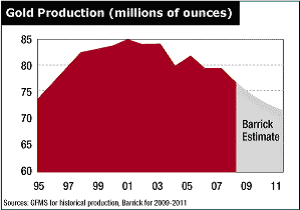
Annual worldwide mine production of gold has decreased by 9.3% since 2001. Considering gold prices have nearly quadrupled since then, why isn’t more gold being produced? The answer is simple. Resources are being depleted and their quality is diminishing. And, when a discovery is made, it takes about 7-10 years to get a mine permitted and into production – making it difficult to quickly ramp up gold production.
BUY GOLD PRODUCTS
Gold Trend #2: Gold is Getting Harder to Find.
Fewer and fewer large gold discoveries are being made every year. And the discoveries that are being made tend to be in more remote and less geopolitically attractive areas. Considering that the risks to opening any gold mine are considerable, mining companies just aren’t interested in mining in areas that have significant political and geographical drawbacks. As a result, miners are having difficulty replacing depleted resources.
Gold Trend #3: Investment Demand for Gold.
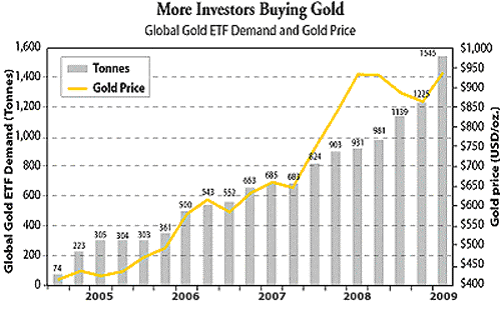
Large institutional investors, such as hedge and pension funds, are making large allocations to gold and gold shares. Individual investors are also getting in on the action, with gold exchange-traded funds (ETFs) gaining influence. SPDR Gold Trust (NYSE: GLD), the largest physically backed ETF on the planet, is now the 6th biggest holder of gold bullion with more than 1000 tons. That is helping to facilitate and spread the ownership of gold by individuals. In fact, in the first half of 2009 investment demand for gold is up 150% over the first half of 2008, according to the World Gold Council.
WHAT ARE YOU WAITING FOR? BUY SOME GOLD FOR YOURSELF NOW!
Gold Trend #4: Central Banks are Buying Gold.
The Central Bank Gold Agreement, originally signed in 2001 and recently renewed for another five years, limits the amount of gold European central banks – including the International Monetary Fund – can sell to 400 tons per year. This means that even if governments want to sell off their gold reserves, they can’t – further straining the supply of gold on the market. The U.S., the world’s largest holder of gold, is holding on to their stash as well. Some governments are going even further: Venezuela’s Finance Ministry now requires 70% of gold produced in the country to be sold domestically. At the same time, Russia, Ecuador, Mexico and the Philippines are all buying gold. And China has increased its reserves by a staggering 76%.
Gold Trend #5: Push for Gold-backed Currencies.
As investors the world over lose faith in their government’s ability to contain the financial and economic crises, many are calling for gold backed currencies – much like the U.S. dollar was until the early 1970’s. Even Zimbabwe, which a year ago had hyperinflation running at 231 million percent annually, is now considering reintroducing its Zimbabwe dollar, but this time fully backed by assets, including gold. In order for this to happen, countries would have to purchase enough gold to back all their currency – putting extreme pressure on the gold supply.
BUY GOLD PRODUCTS
Gold Trend #6: Asian Demand for Gold is Exploding.
Asia, with its more than two and a half billion people, has a major impact on investment demand. Asians have a long-standing cultural affinity for gold as a store of wealth. India is the world’s largest gold consumer. For the last 50 years, until 2009, the Chinese government has forbidden its citizens from owning gold. But now China is encouraging its citizens to buy silver – which automatically draws more attention to gold. Today, Chinese investors even have access to gold-linked checking accounts. As a result, demand for gold in mainland China is expected to triple in the next few years.
Gold Trend #7: Gold is in a Secular Bull Market.

Gold’s price has increased every single year since 2001. This is a clear signal that we are currently in the middle of a secular bull market for gold. A secular bull market typically last about 17 years and ends with a mania stage where investors throw the concept of supply and demand out the window and frantically invest in gold. We’ve seen this same pattern repeat itself over the last hundred years of investment history and we’re about to see a major run up in gold prices. The gold market is very small in relation to the currency, bond or stock markets, so when investors start to pile in, look out. Prices will go through the roof – making the tech and housing bubbles seem small in comparison.
YOU CAN BUY GOLD PRODUCTS HERE
We’ve all heard that inflation drives up gold prices. When inflation is on the rise, investors buy more gold to hedge their portfolios.
And, with all the government bailouts and stimulus packages, it’s hard to deny that inflation is coming. After all, the money supply has more than doubled since October.
Yet few people realize that inflation may be the least of the reasons why gold prices will push higher.
Since bottoming out in 2001, gold prices have risen by nearly 300% and is now trading above the $1,100. And that’s happened in a relatively “inflation-free zone.”
There are other forces at work here. This report will show you exactly why inflation is only a small part of the gold story. And, we’ll identify the best ways to profit from the coming gold rush.
Gold Trend #1: Gold Mine Production is Decreasing.
Annual worldwide mine production of gold has decreased by 9.3% since 2001. Considering gold prices have nearly quadrupled since then, why isn’t more gold being produced? The answer is simple. Resources are being depleted and their quality is diminishing. And, when a discovery is made, it takes about 7-10 years to get a mine permitted and into production – making it difficult to quickly ramp up gold production.
BUY GOLD PRODUCTS
Gold Trend #2: Gold is Getting Harder to Find.
Fewer and fewer large gold discoveries are being made every year. And the discoveries that are being made tend to be in more remote and less geopolitically attractive areas. Considering that the risks to opening any gold mine are considerable, mining companies just aren’t interested in mining in areas that have significant political and geographical drawbacks. As a result, miners are having difficulty replacing depleted resources.
Gold Trend #3: Investment Demand for Gold.
Large institutional investors, such as hedge and pension funds, are making large allocations to gold and gold shares. Individual investors are also getting in on the action, with gold exchange-traded funds (ETFs) gaining influence. SPDR Gold Trust (NYSE: GLD), the largest physically backed ETF on the planet, is now the 6th biggest holder of gold bullion with more than 1000 tons. That is helping to facilitate and spread the ownership of gold by individuals. In fact, in the first half of 2009 investment demand for gold is up 150% over the first half of 2008, according to the World Gold Council.
WHAT ARE YOU WAITING FOR? BUY SOME GOLD FOR YOURSELF NOW!
Gold Trend #4: Central Banks are Buying Gold.
The Central Bank Gold Agreement, originally signed in 2001 and recently renewed for another five years, limits the amount of gold European central banks – including the International Monetary Fund – can sell to 400 tons per year. This means that even if governments want to sell off their gold reserves, they can’t – further straining the supply of gold on the market. The U.S., the world’s largest holder of gold, is holding on to their stash as well. Some governments are going even further: Venezuela’s Finance Ministry now requires 70% of gold produced in the country to be sold domestically. At the same time, Russia, Ecuador, Mexico and the Philippines are all buying gold. And China has increased its reserves by a staggering 76%.
Gold Trend #5: Push for Gold-backed Currencies.
As investors the world over lose faith in their government’s ability to contain the financial and economic crises, many are calling for gold backed currencies – much like the U.S. dollar was until the early 1970’s. Even Zimbabwe, which a year ago had hyperinflation running at 231 million percent annually, is now considering reintroducing its Zimbabwe dollar, but this time fully backed by assets, including gold. In order for this to happen, countries would have to purchase enough gold to back all their currency – putting extreme pressure on the gold supply.
BUY GOLD PRODUCTS
Gold Trend #6: Asian Demand for Gold is Exploding.
Asia, with its more than two and a half billion people, has a major impact on investment demand. Asians have a long-standing cultural affinity for gold as a store of wealth. India is the world’s largest gold consumer. For the last 50 years, until 2009, the Chinese government has forbidden its citizens from owning gold. But now China is encouraging its citizens to buy silver – which automatically draws more attention to gold. Today, Chinese investors even have access to gold-linked checking accounts. As a result, demand for gold in mainland China is expected to triple in the next few years.
Gold Trend #7: Gold is in a Secular Bull Market.
Gold’s price has increased every single year since 2001. This is a clear signal that we are currently in the middle of a secular bull market for gold. A secular bull market typically last about 17 years and ends with a mania stage where investors throw the concept of supply and demand out the window and frantically invest in gold. We’ve seen this same pattern repeat itself over the last hundred years of investment history and we’re about to see a major run up in gold prices. The gold market is very small in relation to the currency, bond or stock markets, so when investors start to pile in, look out. Prices will go through the roof – making the tech and housing bubbles seem small in comparison.
YOU CAN BUY GOLD PRODUCTS HERE
Subscribe to:
Posts (Atom)


 Posts
Posts


