GOLD & SILVER SPOT PRICES

GOLD & SILVER - 10 YEARS PRICE CHART

Saturday, January 23, 2010

The Fear Index

By James Turk


The Fear Index remains within its decade-long bullish uptrend, so we therefore know as a consequence that gold also remains within an uptrend.  But the Fear Index is also giving us another important message.  It is that gold remains undervalued.

Gold’s valuation is indispensable information given its exceptional appreciation this decade.  In other words, even though gold has risen nine years in a row against the US dollar, it remains relatively cheap.  This conclusion is illustrated with the following chart.
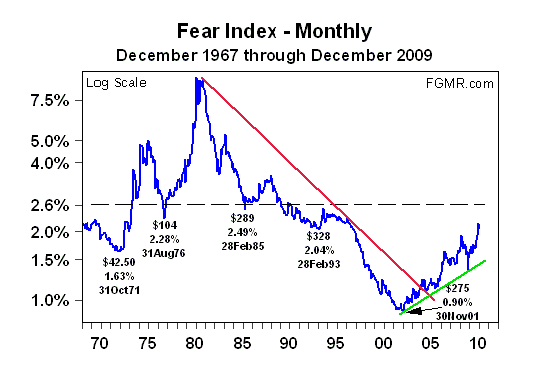
The dashed horizontal line on this chart marks 2.63%, which is the average value of the Fear Index since August 1971.  That is the date when President Nixon – with total disregard to the US dollar’s 180-year history – turned the dollar into irredeemable fiat currency, in effect declaring by presidential edict that the monetary requirements of the Constitution were null and void.

The Fear Index is presently 2.05%.  Note that it is lower today than August 1976 when the Fear Index was 2.28% and gold was $104.  Therefore, gold at $1106 – its December 31, 2009 price – is even more undervalued than it was at $100 back in 1976.  How is that possible?  How can gold be more than 10-times more ‘expensive’ today and still be better value?

Simple.  A 2010-dollar is not the same as a 1976-dollar.  The dollar’s name has not changed, but the dollar has been terribly debased over the past 34 years.  It has lost much of its moneyness – its innate value as money – in two insidious ways.

It has lost purchasing power because of inflation.

Secondly, it also has 0.23% less gold-backing today than it did at the low point of the Fear Index in 1976.  Even though dollars can no longer be redeemed for gold, dollars are still partially backed by gold.  The Fear Index measures to what extent gold backs the dollar, assuming of course that the 261.5 million ounces in the US Gold Reserve really exist and have not been loaned out, encumbered or put in play as part of the gold price suppression scheme led by the US government.

What is clear from the above chart is that one cannot use the dollar price of gold to determine whether or not gold is good value.  The purchasing power of the dollar and the extent of its gold-backing are ever-changing.  So the dollar is not a good measuring stick.  It is not a numéraire.

The important conclusion from the above chart is that gold remains relatively cheap.  We should therefore continue to accumulate it.
-------------------------------------------
For reference, the formula to compute the Fear Index and the value for the Fear Index as of December 31, 2009 are as follows:

Friday, January 22, 2010

Russia’s Central Bank Boosts Gold Holdings


Jan. 21 (Bloomberg) -- Russia’s central bank addded 800,000 troy ounces of gold to its reserves last month, increasing its holdings of the metal in dollar terms to $22.4 billion as of Jan. 1, Bank Rossii said on its Web site.
The bank’s gold reserves climbed to 20.5 million ounces from 19.7 million the previous month.
Source : Bloomberg News

Central Banks around the world are buying up gold.  What about you?

Thursday, January 21, 2010

MORE MONEY PRINTING - To fund An Unsustainable Economy

By ANDREW TAYLOR, Associated Press Writer – Wed Jan 20

WASHINGTON – Senate Democrats on Wednesday proposed allowing the federal government to borrow an additional $1.9 trillion to pay its bills, a record increase that would permit the national debt to reach $14.3 trillion.


The unpopular legislation is needed to allow the federal government to issue bonds to fund programs and prevent a first-time default on obligations. It promises to be a challenging debate for Democrats, who, as the party in power, hold the responsibility for passing the legislation.

It's hardly the debate Democrats want or need in the wake of Sen.-elect Scott Brown's victory in Massachusetts. Arguing over the debt limit provides a forum for Republicans to blame Democrats for rising deficits and spiraling debt, even though responsibility for the government's financial straits can be shared by both political parties.

The measure came to the floor under rules requiring 60 votes to pass. That's an unprecedented step that could mean that every Democrat, no matter how politically endangered, may have to vote for it next week before Brown takes office and Democrats lose their 60-vote majority. Democratic leaders are also worried that Sen. Evan Bayh, D-Ind., who opposed the debt limit increase approved last month, will vote against the measure.


The record increase in the so-called debt limit is required because the budget deficit has spiraled out of control in the wake of a recession that cut tax revenues, the Wall Street bailout, and increased spending by the Democratic-controlled Congress. Last year's deficit hit a phenomenal $1.4 trillion, and the current year's deficit promises to be as high or higher.
Congress has never failed to increase the borrowing limit.

"We have gone to the restaurant. We have eaten the meal. Now the only question is whether we will pay the check," said Finance Committee Chairman Max Baucus, D-Mont. "We simply must do so."
A White House policy statement said the increase "is critically important to make sure that financing of federal government operations can continue without interruption and that the creditworthiness of the United States is not called into question."

China Buying Less U.S. Debt

Jan. 20 (Bloomberg) -- China, which cut Treasury holdings by the most in five months in November, may scale back purchases of U.S. debt on concern the dollar will decline, said Liu Yuhui, an economist at the Chinese Academy of Social Sciences.

The Asian nation’s investors, the biggest foreign holders of U.S. government debt, trimmed holdings by $9.3 billion in November to $789.6 billion, a Treasury Department report showed yesterday. The decline came even as Chinese foreign-exchange reserves swelled $61 billion in the month.

“China may reduce purchases of U.S. Treasuries because there has been no sign the dollar’s long-term trend of weakness will change,” said Liu, director of the Center for Chinese Economic Evaluation in Beijing at CASS, a government-backed research body.

Gold Holdings of Countries

We have been reading news of Central Banks buying up gold as they move away from the traditional safe haven; the US Dollar.  This is a reversal of Central Bank policies in the 1980's where they sold away their gold, resulting in gold prices plummeting to about US$250 per troy ounce.

Look at the table below and look at the Gold Holdings as a percentage of the Nation's reserves.  Look at the numbers for amongst the largest Creditor Nations of the word today; China, Taiwan and Singapore.

Given that the US government's policy of printing more dollars to fund unsustainable projects, more Central Banks are turning to gold, buying them up as and when they become available.  Nobody wants to be left holding US Treasury Bills.

The buying of gold by Central Banks has started as they seek to increase their percentage of gold in their portfolio.  As demand increases... the price of gold will rise too...


WORLD OFFICIAL GOLD HOLDING (December 2009)
Rank
Country/Organization
Gold

(tonnes)
Gold's share

of national

forex reserves
(%)
1
United States United States
8,133.5
68.7%
2
Germany Germany
3,407.6
64.6%
3
International Monetary Fund
3,005.3
-
4
Italy Italy
2,451.8
63.4%
5
France France
2,435.4
64.2%
6
People's Republic of China China
1,054.0
1.5%
7
Switzerland Switzerland
1,040.1
28.8%
8
Japan Japan
765.2
2.4%
9
Netherlands Netherlands
612.5
51.7%
10
Russia Russia
607.7
4.7%
11
India India
557.7
6.4%
12
European Union European Central Bank
501.4
19.6%
13
Republic of China Taiwan
423.6
4.1%
14
Portugal Portugal
382.5
83.8%
15
Venezuela Venezuela
356.4
35.7%
16
United Kingdom United Kingdom
310.3
15.2%
17
Lebanon Lebanon
286.8
26.5%
18
Spain Spain
281.6
34.6%
19
Austria Austria
280.0
52.7%
20
Belgium Belgium
227.5
31.8%
21
Algeria Algeria
173.6
3.8%
22
Philippines Philippines
154.7
12.1%
23
Libya Libya
143.8
4.6%
24
Saudi Arabia Saudi Arabia
143.0
10.2%
25
Singapore Singapore
127.4
2.3%
26
Sweden Sweden
125.7
8.6%
27
South Africa South Africa
124.8
10.5%
28
Bank for International Settlements
120.0
-
29
Turkey Turkey
116.1
5.2%
30
Greece Greece
112.4
71.5%
31
Romania Romania
103.7
7.4%
32
Poland Poland
102.9
4.4%
33
Thailand Thailand
84.0
2.1%
34
Australia Australia
79.9
6.0%
35
Kuwait Kuwait
79.0
11.4%
36
Egypt Egypt
75.6
7.4%
37
Kazakhstan Kazakhstan
74.5
12.0%
38
Indonesia Indonesia
73.1
3.9%
39
Denmark Denmark
66.5
2.8%
40
Pakistan Pakistan
65.4
15.8%
41
Argentina Argentina
54.7
3.7%
42
Finland Finland
49.1
15.1%
43
Bulgaria Bulgaria
39.9
7.1%
44
West African Economic and Monetary Union
36.5
9.9%
45
Malaysia Malaysia
36.4
1.3%
46
Peru Peru
34.7
3.6%
47
Brazil Brazil
33.6
0.5%
48
Slovakia Slovakia
31.8
60.3%
49
Bolivia Bolivia
28.3
11.0%
50
Belarus Belarus

FORMER TOP ACCOUNTANT OF USA: "AMERICAN ECONOMY UNSUSTAINABLE"

Greece, Ireland and Spain are reported to be facing huge sovereign debt issues.  Developed and sovereign countries going bankrupt? Who would have thought this was possible?

Who then is David Walker?  ....
He was formerly the TOP Accountant of the US government.  Therefore, his chilling revelations will make you think .... his findings and conclusion?
US is in massive debt trouble and The American Economy is Unsustainable.


The American National Debt Counter


GOLD vs US Dollar

MAJOR HIGHLIGHTS

Spot Gold prices ended in the green on Tuesday despite strength in the dollar.

International demand for US assets rises on the back of record bond purchases.

MARKET RECAP

Spot Gold prices gained on Tuesday despite a stronger dollar as demand for the yellow metal as a safe-haven increased as markets became wary ahead a host of economic data releases in the later part of the week from the US and China. Gold prices could trade higher in this week as expectations of further weakness in the dollar could support an upside. Officials of the Federal Reserve Bank said yesterday that lending rates in the US may remain low for as long as two years.

The Federal Reserve has kept its target rate at zero percent to 0.25% since December 2008 to revive the economy. Lower interest rates in the US reiterate that the world’s largest economy is still struggling with the worst financial crisis. This concern over economic growth could trigger traditional safe-haven demand for gold. Economic data from the US has come on the negative side and indicates that the world’s largest economy is still fragile.

On the Currency front, the Euro weakened sharply against the dollar on Tuesday after German ZEW index came in much weaker than expected at 47.2 in January versus expectation of 49.5. The Indian Rupee depreciated on Tuesday as strength in the dollar put pressure on the currency. Strength in the dollar coupled with a decline in equities led to depreciation in the currency.

OUTLOOK

On expectations of lower interest rate in the US, the dollar is expected to weaken further. Weakness in the dollar will help gold prices as a weaker dollar will make the yellow metal look attractive for holders of other currencies. In 2009, the rise in gold prices was mainly backed by the weakness in the dollar. Gold prices could continue to witness an uptrend in prices and the bullish phase in the yellow metal could continue.

On intraday basis, Spot Gold prices have immediate support at $1130/$1123 whereas resistance is seen at $1143/$1150. Spot Silver prices shall find support at $18.45/$18.20 whereas resistance is seen at $18.90/$19.10.