GOLD & SILVER SPOT PRICES

GOLD & SILVER - 10 YEARS PRICE CHART

Thursday, February 25, 2010

I Should Have Bought GOLD


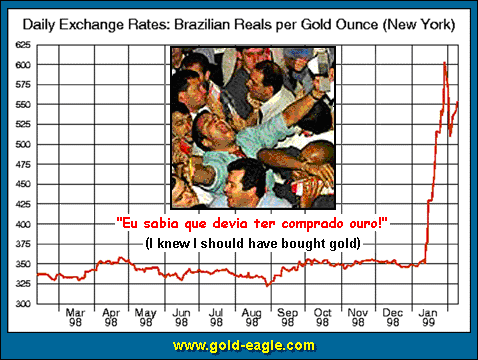
All should be moved by the following dramatic picture and eye-popping gold price charts. The first is an actual photo of currency traders in Sao Paulo, Brazil in early 1999.
The chart shows how the Brazilian currency (called the "real") price of gold soared nearly 80% in a two week period in January 1999. I believe the US dollar price rise of gold will be equally dramatic, violent and without notice sometime during the next 6-8 months.
Economic and monetary crisis overwhelmed Brazil - as it did a few years later to Argentina and twice in Venezuela...and is a 'preview' of what the US may well see during 2010
To use apropos Chinese cliché, "a picture is worth a 1,000 words"


--------BRAZIL JANUARY 1999
"Eu sabia que devia ter comprador ouro!"
"I KNEW I SHOULD HAVE BOUGHT GOLD"


This Brazilian picture will likely be replayed in a theater near you…in the not too distant future. ....around the globe in all countries.

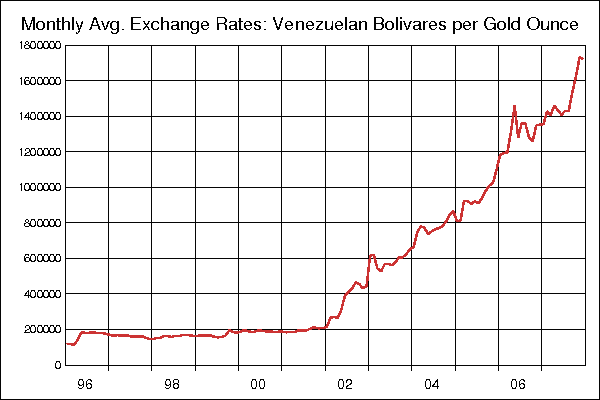
--------VENEZUELA JANUARY 2002
Yo sabia que debia haber comprado el oro!
"I KNEW I SHOULD HAVE BOUGHT GOLD"


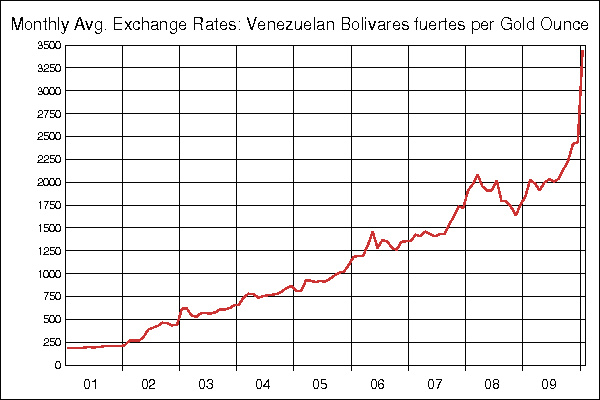
The price of gold denominated in Venezuelan Bolivars soared 800% in six years…that's +133% per year for 6 years.

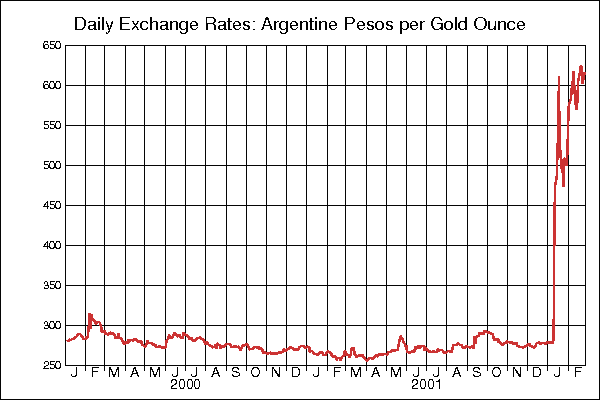
--------ARGENTINA JANUARY 2002
Yo sabia que debia haber comprado el oro!
"I KNEW I SHOULD HAVE BOUGHT GOLD"


The price of gold denominated in Argentine Pesos soared 125% in less than TWO MONTHS.

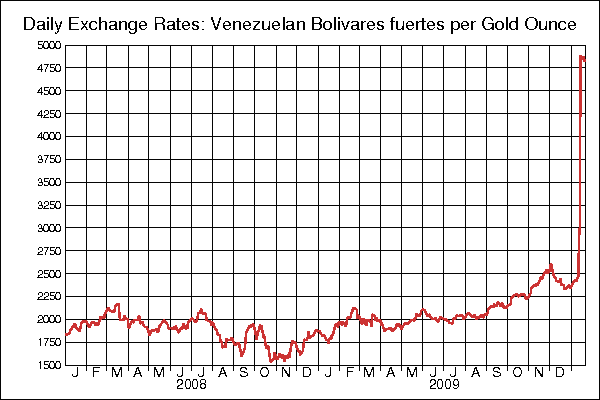
--------VENEZUELA JANUARY 2010
Yo sabia que debia haber comprado el oro!
"I KNEW I SHOULD HAVE BOUGHT GOLD"


To be sure, the Venezuelan nightmare began 9 years ago. Since then the Bolivar value of gold has soared +1,240 percent, that's an average increase of +136% PER YEAR FOR NINE YEARS. See 9 year chart:


Consequently, one is either on-board...or left at the station with a bag full of fiat paper, wringing his hands and screaming his lungs out:
"I KNEW I SHOULD HAVE BOUGHT GOLD!"
"Yo sabia que debia haber comprado el oro!"
"Eu sabia que devia ter comprador ouro!"

However you want to say it, never leave home without some investment in precious metals. Your personal real wealth depends on it.
Unfortunately, by yearend some hapless investors who only listen to CNBC will be crying in their beer, mumbling, "I cudda, I wudda, I shudda..."

Tuesday, February 23, 2010

Einhorn Joins Billionaire Peers in Bets on Gold


Count David Einhorn, the head of Greenlight Capital, among the hedge fund stars betting big on gold.
The stake puts him in the company of luminaries like John Paulson and George Soros, who both reported large year-end stakes in gold-oriented equities.
Einhorn has also reportedly been seeing opportunities in the financial space, where he has joined real estate developer Stephen Ross and other investors in an entity that intends to bid on failing banks, according to Reuters.

Wednesday, January 27, 2010

Gold Commentary

John Embry, who is the Chief Investment Strategist of Sprott Asset Management reported the following in the Investor's Digest of Canada; vol 42 No.1:
  1. US jobs report for December was manipulated; given false hope that the US economy was improving.  This false reporting halted the rise in gold in December 2009.
  2. US debt problem is much larger than the sovereign debt of Greece. So why was there a rally in the US Dollar? 
  3. Urban Myth : the idea that the US dollar and by extension, US financial assets continue to represent a safe haven
  4. Appalled to see Ben Bernanke selected as Time Magazine's Person of the Year for 2009.

Tuesday, January 26, 2010

The US Dollar - Where is It Heading?

What has US Congressman Ron Paul have to say about the US Dollar?
What has famed economist Marc Faber have to say about the US Dollar?

They both agree about the fate of the currency...... so be warned....!!!


"Everybody knows that the US Dollar will crash but nobody knows when it will start...... this is frightening since the banks usually knows these stuff...."


Monday, January 25, 2010

FED Chairman Ben Bernanke's Re-Appointment

So what does Jim Rogers think about Ben Bernanke - the Time Magazine's Person of the Year?


Economic Black Hole: 20 Reasons Why The U.S. Economy Is Dying And Is Simply Not Going To Recover


Even though the U.S. financial system nearly experienced a total meltdown in late 2008, the truth is that most Americans simply have no idea what is happening to the U.S. economy.  Most people seem to think that the nasty little recession that we have just been through is almost over and that we will be experiencing another time of economic growth and prosperity very shortly.  But this time around that is not the case.  The reality is that we are being sucked into an economic black hole from which the U.S. economy will never fully recover.
The problem is debt.  Collectively, the U.S. government, the state governments, corporate America and American consumers have accumulated the biggest mountain of debt in the history of the world.  Our massive debt binge has financed our tremendous growth and prosperity over the last couple of decades, but now the day of reckoning is here.
And it is going to be painful.
The following are 20 reasons why the U.S. economy is dying and is simply not going to recover....
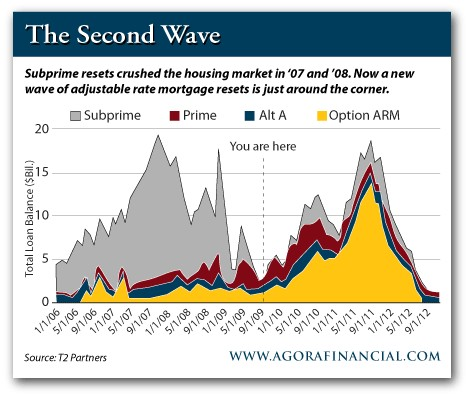
#1) Do you remember that massive wave of subprime mortgages that defaulted in 2007 and 2008 and caused the biggest financial crisis since the Great Depression?  Well, the "second wave" of mortgage defaults in on the way and there is simply no way that we are going to be able to avoid it.  A huge mountain of mortgages is going to reset starting in 2010, and once those mortgage payments go up there are once again going to be millons of people who simply cannot pay their mortgages.  The chart below reveals just how bad the second wave of adjustable rate mortgages is likely to be over the next several years....
#2) The Federal Housing Administration has announced plans to increase the amount of up-front cash paid by new borrowers and to require higher down payments from those with the poorest credit.  The Federal Housing Administration currently backs about 30 percent of all new home loans and about 20 percent of all new home refinancing loans.  Tighter standards are going to mean that less people will qualify for loans.  Less qualifiers means that there will be less buyers for homes.  Less buyers means that home prices are going to drop even more.
#3) It is getting really hard to find a job in the United States.  A total of 6,130,000 U.S. workers had been unemployed for 27 weeks or more in December 2009.  That was the most ever since the U.S. government started keeping track of this statistic in 1948.  In fact, it is more than double the 2,612,000 U.S. workers who were unemployed for a similar length of time in December 2008.  The reality is that once Americans lose their jobs they are increasingly finding it difficult to find new ones.  Just check out the chart below....

#4) In December, there were also 929,000 "discouraged" workers who are not counted as part of the labor force because they have "given up" looking for work.  That is the most since the U.S. government first started keeping track of discouraged workers in 1949.  Many Americans have simply given up and are now chronically unemployed.
#5) Some areas of the U.S. are already virtually in a state of depression.  The mayor of Detroit estimates that the real unemployment rate in his city is now somewhere around 50 percent.
#6) For decades, our leaders in Washington pushed us towards "a global economy" and told us it would be so good for us.  But there is a flip side.  Now workers in the U.S. must compete with workers all over the world, and our greedy corporations are free to pursue the cheapest labor available anywhere on the globe.  Millions of jobs have already been shipped out of the United States, and Princeton University economist Alan S. Blinder estimates that 22% to 29% of all current U.S. jobs will be offshorable within two decades.  The days when blue collar workers could live the American Dream are gone and they are not going to come back. 
#7) During the 2001 recession, the U.S. economy lost 2% of its jobs and it took four years to get them back. This time around the U.S. economy has lost more than 5% of its jobs and there is no sign that the bleeding of jobs is going to stop any time soon.
#8) All of this unemployment is putting severe stress on state unemployment funds.  At this point, 25 state unemployment insurance funds have gone broke and the Department of Labor estimates that 15 more state unemployment funds will likely go broke within two years and will need massive loans from the federal government just to keep going.
#9) 37 million Americans now receive food stamps, and the program is expanding at a pace of about 20,000 people a day.  The United States of America is very quickly becoming a socialist welfare state.
#10) The number of Americans who are going broke is staggering.  1.41 million Americans filed for personal bankruptcy in 2009 - a 32 percent increase over 2008.
#11) For decades, the fact that the U.S. dollar was the reserve currency of the world gave the U.S. financial system an unusual degree of stability.  But all of that is changing.  Foreign countries are increasingly turning away from the dollar to other currencies.  For example, Russia’s central bank announced on Wednesday that it had started buying Canadian dollars in a bid to diversify its foreign exchange reserves.
#12) The recent economic downturn has left some localities totally bankrupt.  For instance, Jefferson County, Alabama is on the brink of what would be the largest government bankruptcy in the history of the United States - surpassing the 1994 filing by Southern California's Orange County.
#13) The U.S. is facing a pension crisis of unprecedented magnitude.  Virtually all pension funds in the United States, both private and public, are massively underfunded.  With millions of Baby Boomers getting ready to retire, there is simply no way on earth that all of these obligations can be met.  Robert Novy-Marx of the University of Chicago and Joshua D. Rauh of Northwestern's Kellogg School of Management recently calculated the collective unfunded pension liability for all 50 U.S. states for Forbes magazine.  So what was the total?  3.2 trillion dollars.
#14) Social Security and Medicare expenses are wildly out of control.  Once again, with millions of Baby Boomers now at retirement age there is simply going to be no way to pay all of these retirees what they are owed.
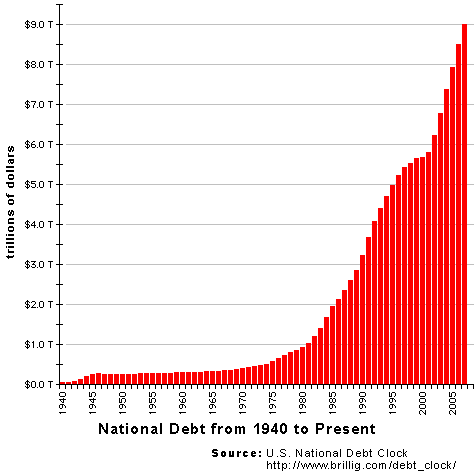
#15) So will the U.S. government come to the rescue?  The U.S. has allowed the total federal debt to balloon by 50% since 2006 to $12.3 trillion.  The chart below is a bit outdated, but it does show the reckless expansion of U.S. government debt over the past several decades.  To get an idea of where we are now, just add at least 3 trillion dollars on to the top of the chart....

#16) So has the U.S. government learned anything from these mistakes?  No.  In fact, Senate Democrats on Wednesday proposed allowing the federal government to borrow an additional $2 trillion to pay its bills, a record increase that would allow the U.S. national debt to reach approximately $14.3 trillion.
#17) It is going to become even harder for the U.S. government to pay the bills now that tax receipts are falling through the floor.  U.S. corporate income tax receipts were down 55% in the year that ended on September 30th, 2009.
#18) So where will the U.S. government get the money?  From the Federal Reserve of course.  The Federal Reserve bought approximately 80 percent of all U.S. Treasury securities issued in 2009.  In other words, the U.S. government is now being financed by a massive Ponzi scheme.
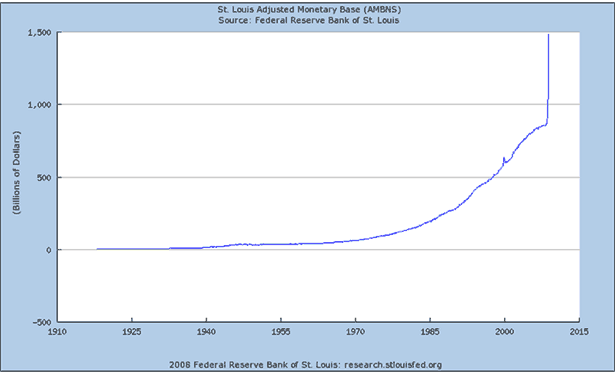
#19) The reckless expansion of the money supply by the U.S. government and the Federal Reserve is going to end up destroying the U.S. dollar and the value of the remaining collective net worth of all Americans.  The more dollars there are, the less each individual dollar is worth.  In essence, inflation is like a hidden tax on each dollar that you own.  When they flood the economy with money, the value of the money you have in your bank accounts goes down.  The chart below shows the growth of the U.S. money supply.  Pay particular attention to the very end of the chart which shows what has been happening lately.  What do you think this is going to do to the value of the U.S. dollar?....
#20) When a nation practices evil, there is no way that it is going to be blessed in the long run.  The truth is that we have become a nation that is dripping with corruption and wickedness from the top to the bottom.  Unless this fundamentally changes, not even the most perfect economic policies in the world are going to do us any good.  In the end, you always reap what you sow.  The day of reckoning for the U.S. economy is here and it is not going to be pleasant.

SILVER - The Undervalued Commodity

Silver prices still have a long way to rise before reaching their top. From industrial applications to its relative value, it’s easy to make the case that silver remains one of the most undervalued commodities.

Industrial Silver Fundamentals
Industrial uses for silver are abundant. Ranging from electrical uses to photographic development, silver may be one of the most useful metals known to man.
However, silver prices have yet to reflect the growing applications and uses for the precious metal, despite so many fundamentals suggesting silver prices should rise. Silver’s low price is mostly due to a poor economy, which has seen consumer spending go into a drought. With consumers buying less big ticket items, such as washing machines, computers, and other consumer-grade electronics, which all contain silver, the amount demanded from the industrial sector is under its average.
Luckily, economies do not stay in recessions or depressions forever, and consumer spending, as well as industrial silver demand, should skyrocket with any rebound. Silver’s price should follow closely behind.

Relative Cost
2008 was a record year for virtually every commodity across the board. Oil soared as high as $147, gold pushed towards $850 per ounce, and agricultural commodities rode the rally as well.
However, silver remained behind the pack, moving only as high as $15 per ounce, which is roughly one-third of its all time high set in the 1980s. In fact, silver was the only commodity that had not beaten its previous highs in the last three years.
When compared to energy commodities, gold and even stocks, silver remains heavily undervalued, despite a belief among economists and financial analysts that it represents one of the best investments in 2010 and beyond.

Silver and Gold Relationship
Gold and silver typically trade within a range of 20-70 ounces of silver to the price of gold. Today, the ratio is roughly 62.2 ounces of silver to one ounce of gold, which is the highest it has been in years. This ratio is often used by traders as an oscillator to decide when it is best to move from gold to silver or from silver to gold. When the ratio nears 70, investors buy silver and sell gold. When it nears 20, investors are selling silver to buy gold. This ratio, which has long been important to commodity traders and long-term investors alike, suggests silver is ready for a rally.

Rounding it All Up
Even after rising nearly 350% from its 2000’s low, silver is still heavily undervalued when compared to a slew of other commodities, setting the stage for a continued explosion in price regardless of the changes in other commodity prices. Moving forward, silver has not only the fundamentals driving growth in consumption, but also investment, as more and more investors realize the untapped potential that resides in a healthy stock of silver.

There is little time to wait, as silver’s explosion could be just around the corner. Should silver prices make a modest move from 1/62 of the price of gold to 1/40, investors will be rewarded with a healthy 50% in returns. The time to invest is now, long before Wall Street realizes what a true bargain silver is.